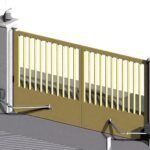

Choosing the right automatic sliding gate opener is about more than just convenience; it is about security, longevity, and finding the perfect mechanical match for your specific driveway conditions.
If you are in the market for a sliding gate operator, you have likely encountered the two main drive mechanisms: Chain Drive and Rack and Pinion (Gear Drive). While both serve the same purpose—moving your gate—they do so in very different ways.
In this guide, we will break down the technical differences, pros and cons, and operational environments for each type to help you make an informed decision.
1. The Chain Drive Sliding Gate Opener
The chain drive system is the traditional workhorse of the gate automation world. It operates similarly to a bicycle chain: a roller chain runs across the length of the gate, connecting to the motor’s sprocket. As the motor turns, it pulls the chain, sliding the gate open or closed.
See It in Action
The chain drive mechanism is known for its visibility and industrial look. You can see how the chain engages with the motor in this operation video: ▶ Watch the Chain Drive Sliding Gate Opener in Action
When to Choose Chain Drive:
- Uneven Terrain: This is the chain drive’s biggest advantage. Chains have a degree of “slack” or vertical tolerance. If your driveway is bumpy, has a dip, or if the gate wobbles slightly as it moves, the chain system can absorb these imperfections without jamming.
- Heavy Duty / Industrial Applications: Chain drives are often perceived as more robust for older, heavy gates that might not be perfectly leveled.
- Ease of Retrofitting: If you are automating an existing gate that has settled over time, a chain drive is often more forgiving during installation.
Pros:
- High tolerance for uneven ground.
- Robust and durable for heavy gates.
- Forgiving installation tolerances.
Cons:
- Noise: The metal-on-metal contact between the chain and sprocket tends to be noisier.
- Maintenance: Chains stretch over time and require periodic tightening and lubrication.
- Aesthetics: The chain is visible across the gate, which some homeowners find less visually appealing.
2. The Rack and Pinion Sliding Gate Opener
The Rack and Pinion (often called “Gear Drive”) is the modern standard for residential sliding gates. In this system, a toothed rack is mounted directly onto the gate itself. The motor has a corresponding gear (pinion) that meshes with this rack. As the gear spins, it moves the rack—and the gate—smoothly along the track.
See It in Action
Notice the difference in sound and movement? The gear drive offers a much smoother, quieter operation. Check out the rack drive performance here: ▶ Watch the Rack and Pinion Sliding Gate Opener in Action
When to Choose Rack and Pinion:
- Residential Properties: If you want a “stealth” look where the mechanism is hidden and silent, this is the superior choice.
- Flat, Level Ground: Because the gear teeth must mesh perfectly with the rack, the gate cannot bounce up and down. Your driveway and gate track must be level and smooth.
- Precision: These openers stop and start with high precision, making them safer and more responsive to safety sensors.
Pros:
- Quiet Operation: Almost silent compared to chains.
- Aesthetics: The rack is usually mounted low and painted to match the gate, making it nearly invisible.
- Low Maintenance: No chains to tighten or grease. The rack simply needs to be kept free of debris.
- Security: It is generally harder to force open a gear-locked gate than a chain-driven one.
Cons:
- Zero Tolerance for Ground Movement: If the ground shifts or the track is bumpy, the gears can disengage or strip.
- Installation Precision: Requires professional or very careful DIY installation to ensure perfect alignment.
Verdict: Which One Should You Buy?
To summarize the decision process, use this simple checklist:
- Choose Chain Drive If: Your driveway is sloped, uneven, or gravel; you are retrofitting an old gate that isn’t perfectly straight; or you are in an industrial setting where noise isn’t a concern.
- Choose Rack and Pinion If: You have a paved, level driveway; you want the quietest possible operation for a home environment; and you prefer a clean, modern look without visible chains.
Both systems are reliable when installed correctly, but matching the drive type to your environment is the key to a long-lasting automated gate.