
Installing an automatic gate opener is a great way to enhance property security and convenience. However, a gate opener is not a “one-size-fits-all” solution. To ensure the system operates smoothly and lasts for years, you must meet specific installation requirements based on the type of gate and the drive mechanism you choose.
This guide breaks down the installation requirements for Sliding Gate Openers and Swing Gate Openers, detailing the specific needs of their different sub-types.
Part 1: Installation Requirements for Sliding Gate Openers
Sliding gate openers are designed for driveways where space is limited. The gate slides horizontally along a fence line. Before installation, you must ensure the gate moves freely manually and that there are physical safety stops (magnetic or mechanical limit switches) at both open and closed positions.
Depending on the drive mechanism, the requirements differ significantly:
1. Chain Drive Sliding Gate Opener
This system uses a bicycle-like chain attached to the gate ends, driven by sprockets on the motor. It is often used for heavy industrial gates or older gates.
- Alignment is Key: The chain must be installed horizontally straight. The motor sprockets and the brackets on the gate ends must align perfectly to prevent the chain from jumping off.
- Proper Tensioning: You must maintain the correct chain tension. If it is too loose, it will sag and slip; if it is too tight, it puts excessive stress on the motor’s gearbox. Regular checks are required.
- Ground Tolerance: This system is more forgiving of uneven ground. If your driveway track has slight bumps or the gate wobbles a bit, the flexible chain system handles it better than a rigid rack system.
2. Rack & Pinion Sliding Gate Opener
This is the modern standard for residential gates. A toothed bar (rack) is mounted on the gate, and a gear (pinion) on the motor meshes with it.
- Gate Stability: The gate must run smoothly without bouncing. If the gate jumps up and down due to a bad track, the rack can disengage or crush the motor gear.
- The Critical “1-2mm Gap”: This is the most important rule. You must leave a gap of approximately 1-2mm between the motor gear and the rack. The gate’s weight must rest entirely on its wheels, never on the motor gear. If the rack sits on the gear, it will destroy the internal gearbox.
- Precision: This system requires a high-quality, level track. It operates much quieter than a chain drive but demands higher installation precision.
Part 2: Installation Requirements for Swing Gate Openers
Swing gate openers are the most common choice for residential properties. Generally, they require sturdy gate posts capable of withstanding torque and a clear swing path free of obstacles (like sloping driveways).
However, installation requirements change based on the three mechanical designs:
1. Crank-Arm Swing Gate Openers
This type features a motor mounted on the side of the pillar, connected to the gate via an articulated arm (like an elbow).
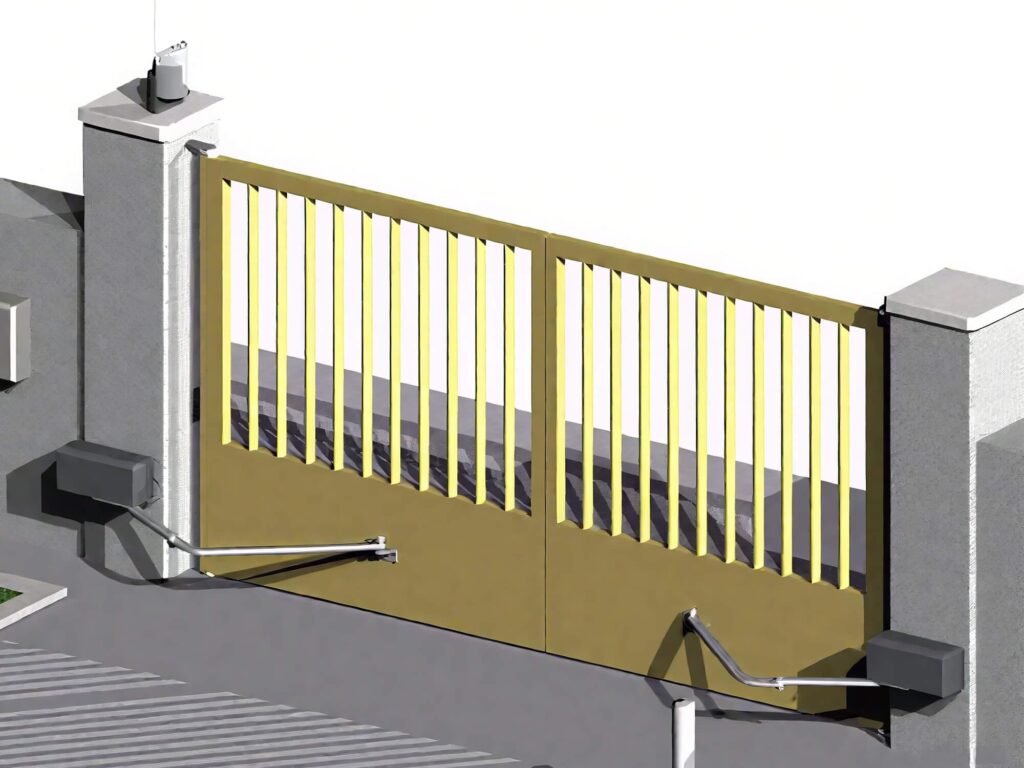
- Side Space: You need sufficient space on the side of the pillar or wall to mount the motor box.
- Geometry: Installation requires precise adjustment of the arm angles. Incorrect angles can cause the gate to move jerkily.
- Uneven Ground Friendly: This is the most flexible option. Because the arm lifts the mechanism off the ground, it works perfectly on driveways that are uneven or where the ground slopes slightly.
2. Push-Rod Swing Gate Openers
Also known as linear actuators, these use a long arm that extends and retracts to move the gate.
- Mounting Geometry: This is the most technically demanding to install. The rear bracket (on the post) and front bracket (on the gate) must be aligned according to specific geometric charts provided by the manufacturer. If these dimensions are off, the gate may not open fully or could bind.
- Opening Angle: Typically, these are limited to an opening angle of about 100–105 degrees. If you need the gate to open wider (e.g., 120 degrees), you need very specific mounting positions or a different type of opener.
- Aesthetics: The arm is visible on the back of the gate, so installation must be neat.
3. Roller-Type Swing Gate Openers
This unique opener has a motor and a wheel installed at the bottom edge of the gate leaf. It drives the gate by rolling along the ground.
- Ground Condition is Critical: The most vital requirement is the ground surface. It must be flat, hard, and level (concrete or asphalt). It cannot work on gravel, dirt, or grass, as the wheel will slip.
- Surface Texture: The ground should not be too smooth (like polished tile), or the wheel might lose traction in wet conditions.
- Anti-Sag Solution: Since the wheel supports the weight of the gate, this is an excellent choice for heavy gates where the pillars or hinges might be too weak to support a standard suspended operator.
Summary: Which One Fits Your Site?
- For Uneven Ground: Use a Chain Drive (Sliding) or Crank-Arm (Swing).
- For Quiet, Modern Homes: Use a Rack & Pinion (Sliding) or Push-Rod (Swing).
- For Heavy Gates with Weak Pillars: Use a Roller-Type (Swing).
By understanding these installation requirements before you buy, you can choose the right automation system that fits your specific environment perfectly.
Contact ACCESS TECH today and describe your installation environment—let our professional team help you select the most suitable gate opener for your needs.