
85% of first-time importers overlook a critical negotiation reality: Chinese suppliers routinely inflate their Minimum Order Quantities by 30-50% as an opening position. That inflated MOQ on the quote you just received? It’s a negotiation anchor, not a fixed requirement.
After 25 years manufacturing gate openers in China, I’ve watched countless buyers make preventable mistakes – overpaying for certifications that aren’t what they appear to be, accepting unfair delivery terms, and choosing partners based on platform ratings that tell half the story.
This guide provides the insider evaluation criteria you need before contacting any supplier on this list. The suppliers ranked here represent genuine manufacturing capability, but knowing how to evaluate them matters more than knowing their names.
How to Evaluate Gate Opener Suppliers Before You Contact Them
Start with certification verification, production capacity indicators, and export experience – not platform ratings. Ratings provide a starting point, but they reward response speed and transaction volume more than product quality.
Certification verification separates serious manufacturers from assemblers. Request copies of CE declarations of conformity (not just certificates), ISO audit reports with dates, and UL 325 listing numbers if you’re importing to the US market. A manufacturer who hesitates to provide documentation has something to hide.
Production capacity indicators reveal whether a supplier can actually fulfill your orders. Ask for factory photos showing CNC equipment, SMT production lines, and quality testing stations. Manufacturers with motor testing equipment and spectrum analyzers invest in quality control. Those relying on visual inspection alone produce inconsistent results.
Export market experience matters because suppliers who regularly ship to the US, Europe, and Australia understand compliance requirements. They know that UL 325 requires two independent safety entrapment devices per zone. They know that CE marking has specific documentation requirements. First-time exporters learn these lessons at your expense.
Request case references of well-known clients from the supplier. Usually, suppliers that serve top-tier brands have more prominent advantages in product quality and design.
Top 10 Gate Opener Suppliers in China (2025)
This ranking prioritizes manufacturing capability, export experience, and certification credentials over catalog breadth or marketing claims.
1. ACCESS TECH
ACCESS TECH, a subsidiary brand of BISEN ACCESS (Bisen Smart Access CO., LTD.), has specialized in manufacturing gate automation equipment since 1999, with a strong focus on heavy-duty applications spanning the full capacity spectrum. Its sliding gate openers cover a wide range from 500kg residential models to 3000kg industrial-grade units, while its swing gate openers offer comparable load-bearing capabilities—benefiting from BISEN ACCESS’s two-plus decades of expertise as a leading global provider of access control and management solutions.
Backed by BISEN ACCESS’s robust industrial foundation, which includes two advanced smart manufacturing bases, annual production and sales of 500,000 sets of access control equipment, and over 280 patents and software copyrights, ACCESS TECH offers 2-year warranty with free parts replacement. Aligned with BISEN ACCESS’s “hardware + platform + service” business model—under which the parent company serves over 80 countries worldwide with one-stop solutions for smart parking, smart parks, and security systems—ACCESS TECH focuses on B2B wholesale partnerships with distributors and integrators, distinguishing itself from consumer-direct competitors.
2. HAIDA Door Control
HAIDA brings 33+ years of experience and substantial infrastructure: three production bases across Zhejiang, Anhui, and Jiangsu provinces totaling 72,000 square meters. Their differentiator is operating a National Test Laboratory as an Intertek Satellite Lab – meaning third-party testing capability on-site.
This testing infrastructure reduces the certification documentation risk that plagues many Chinese manufacturers. When HAIDA provides test reports, they come from an internationally recognized laboratory operating under their roof.
3. Zhejiang Hiland Technology
Hiland operates from Anji County in Huzhou City, Zhejiang Province, with ISO 9001:2008, CE, and RoHS certifications. They provide useful pricing transparency: their SLG52804 model (600kg capacity, 280W, 14Nm torque) lists at approximately $85-93 per piece.
Use Hiland quotes as a pricing benchmark when evaluating other suppliers. Their willingness to publish pricing suggests confidence in their value proposition and simplifies initial comparison.
4. Hangzhou Lijia Motor
Lijia holds ISO 9001:2008, 3C, and CE certifications and emphasizes customization capability and energy-efficient motor design. Their product range covers garage doors, gate openers, AC/DC motors, and controllers.
A disclosure: Lijia publishes competitor content ranking themselves first among Chinese gate opener suppliers. Factor this marketing approach into your evaluation – it doesn’t disqualify them, but it suggests prioritizing independent verification of their claims.
5. CXHA (Automaingate)
CXHA has operated for 20 years with significant scale: 480 workers, 20 R&D engineers (including 5 senior engineers), and a 30,000 square meter factory. Their claimed monthly capacity reaches 10,000 meters of automatic gate production.
Their product focus differs from standard operators, specializing in retractable gates, cantilever gates, and folding gates – complete gate systems rather than operators alone. This integrated approach may simplify procurement for projects requiring gates and operators together.
6. SAFEDOOR (Hangzhou Safedoor Automation & Hardware)
SAFEDOOR has manufactured from Hangzhou for 15+ years, focusing on heavy-duty swing and sliding gate openers for industrial applications. Their industrial focus suggests familiarity with high-cycle-count requirements and durability expectations that differ from residential products.
Limited public information requires direct inquiry for detailed specifications and certifications.
7. Fujian Omker Intelligent Technology
Omker has operated from Fuzhou, Fujian Province for 19 years, building a focused operation of 62 employees with specialized equipment including CNC machining centers, motor testers, and spectrum analyzers. Their ISO 9001 and CE (Complete Machine) certifications cover sliding gate, swing gate, and boom barrier products.
The company exports primarily to the USA, Australia, India, and Southeast Asia – markets with strict compliance requirements. Their Alibaba #1 ranking in Gate Operators class reflects transaction volume rather than independent quality verification, but their equipment investment suggests genuine manufacturing rather than trading company operations.
8. UAUTOGATE (Qinuo Electronics)
UAUTOGATE demonstrates serious manufacturing scale with 200+ employees, including 50+ R&D technicians, operating from a 20-acre facility with 25,000 square meters of dust-free workshop space and five SMT production lines.
Their certification portfolio is extensive: CE, RoHS, WEEE, EN16005, FCC, IC, ISO 9001:2015, IATF 16949:2016, and ISO 14001:2015. The IATF 16949 automotive quality certification indicates stricter quality management systems than standard ISO 9001. They advertise 100% quality check before shipment and support OEM/ODM customization.
9. Nice China (Italian Brand)
Nice operates through its Chinese subsidiary, backed by the Italian parent company’s 40+ year heritage. They position in the premium segment with emphasis on smart home integration and design aesthetics.
Expect premium pricing reflecting the Italian brand positioning. For buyers prioritizing reliability records and established support networks over cost optimization, Nice offers lower procurement risk at higher unit cost.
10. FAAC China (Italian Brand)
FAAC brings 50+ years of global heritage and operates established distribution centers on both US coasts. They lead in rack-and-pinion operator technology and offer the most comprehensive global support network among suppliers on this list.
Like Nice, FAAC commands premium pricing. Their advantage lies in reduced risk for buyers who prioritize support infrastructure and proven track records over cost leadership.
The Certification Trap: CE vs “China Export” Marking
This single visual check protects you from the most common certification fraud in Chinese manufacturing.
The European CE marking indicates conformity with EU health, safety, and environmental requirements. A nearly identical marking – sometimes called “China Export” – means only that the product was manufactured in China. The visual difference is subtle but critical.
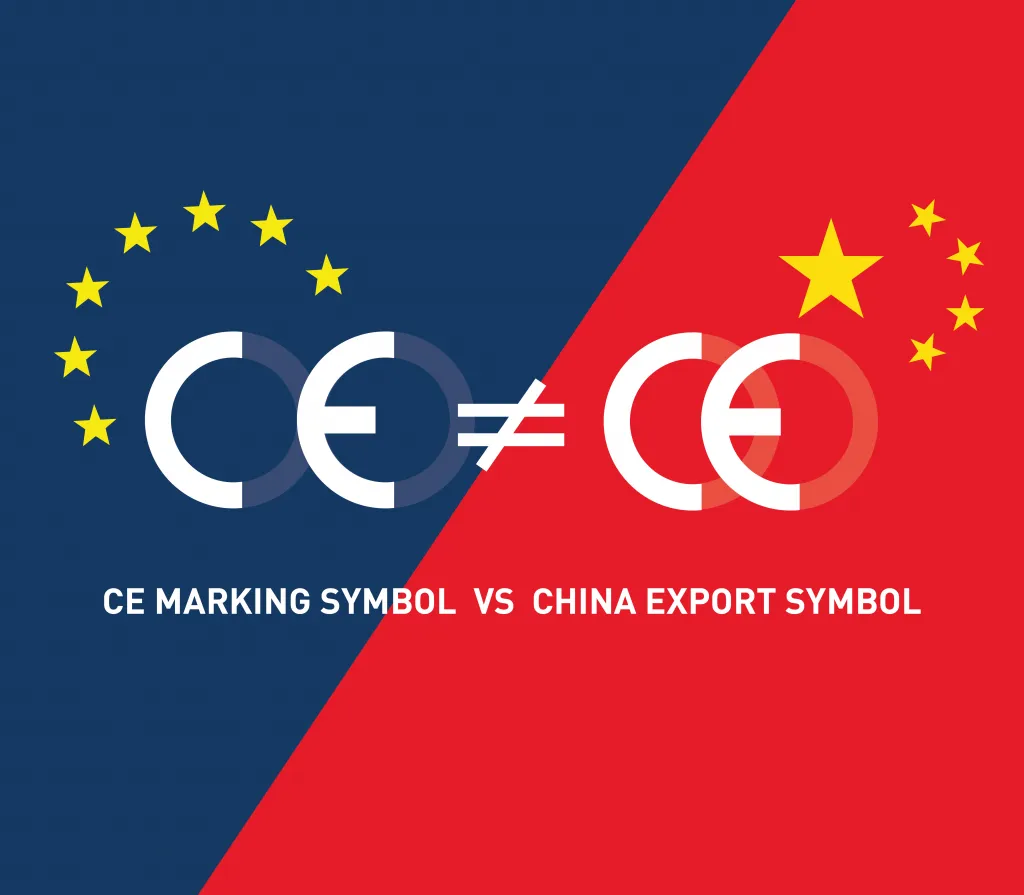
In the legitimate European CE marking, the letters C and E maintain proportional spacing – the center of the E aligns roughly with the outer curve of the C. In the “China Export” version, the letters nearly touch, with minimal space between them.
Some manufacturers apply the China Export marking knowing buyers will assume it indicates European certification. This practice isn’t always intentional fraud – some genuinely don’t understand the distinction – but the result is the same: products that haven’t undergone CE conformity assessment entering markets that require it.
Request the Declaration of Conformity document, not just photos of the CE marking. Legitimate CE compliance requires the manufacturer to maintain technical documentation and a Declaration of Conformity identifying the applicable directives. If a supplier cannot provide these documents, their CE marking likely indicates origin, not conformity.
Negotiating with Chinese Suppliers: What They Won’t Tell You
Chinese suppliers expect negotiation. Published prices and terms represent starting positions, not final offers.
MOQ negotiation yields the most immediate savings. That 100-unit minimum you received? Counter with 50 and expect to settle around 70. First orders especially deserve lower MOQ tolerance because suppliers want to establish relationships. The supplier’s actual production economics often support much lower quantities than their quotes suggest.
Payment terms should follow the 50/50 rule for first orders: 50% deposit upon order confirmation, 50% before shipment after inspection photos or third-party verification. Try not pay 100% upfront with a new supplier, unless they have the goods in stock. Established relationships may move to different terms, but the 50/50 split protects both parties initially.
Lead times require realistic planning. Standard production runs 1-3 weeks depending on order volume, customization requirements, and current factory load. Add 2-4 weeks for shipping. Most critically, add 4-6 weeks buffer around Chinese New Year (late January to mid-February) – factories close for 2-3 weeks and take additional time to resume full production.
Alibaba Trade Assurance provides payment protection on platform orders, but read the terms carefully. Coverage has specific documentation requirements and dispute resolution favors neither party automatically. It is also worth noting that a 3% platform fee applies to Alibaba Trade Assurance orders. For high-value transactions, if the supplier has a proven track record of credibility and reliability, considering a T/T (Telegraphic Transfer) payment method would be a cost-effective alternative to save on the platform fee.
The After-Sales Reality Check
Warranty terms from Chinese suppliers require careful interpretation. A 5-year warranty sounds excellent until you understand enforcement realities.
Many Chinese suppliers offer generous warranty periods because enforcement barriers make claims unlikely. An Australian industry veteran put it directly: some Chinese manufacturers “don’t think it is important” because “their government will not allow returns or replacements under warranty.”
This assessment may be overstated, but the underlying challenge is real. Cross-border warranty claims require shipping defective units to China, waiting for evaluation, and accepting the manufacturer’s determination. The friction often exceeds the product’s value.
After-sales support operates with structural limitations. Customer service typically works through email with overnight response cycles due to time zones. Phone support is rare. Translation quality varies. One buyer described the experience: “emails back and forth… language barrier, having to wait overnight before a reply.” If you encounter urgent after-sales issues requiring immediate resolution, do not hesitate to contact the supplier directly by phone. Proactive phone communication often conveys the urgency of your problem more effectively than delayed email exchanges, prompting the supplier to prioritize your case and provide a faster response.
Factor these limitations into your supplier selection. Premium suppliers like Nice and FAAC command higher prices partly because they offer local support infrastructure. Budget suppliers deliver value through lower unit costs but require you to absorb support friction.
Parts availability matters more than warranty terms for long-term total cost. Control boards and motors fail eventually in any brand. Suppliers who stock replacement parts and ship them independently solve problems faster than those who require complete unit returns.
A counter-intuitive insight: even premium Italian brands use Chinese components on their boards and sometimes use off-the-shelf Chinese motors. The differentiation lies in quality control, consistency, and support infrastructure – not component origin.
Your Next Steps
You now have the evaluation framework that separates informed buyers from those who learn expensive lessons.
Build your shortlist using the criteria above. Select 3-5 suppliers whose manufacturing capability, certification documentation, and export experience match your requirements.
Verify CE marking visually on any samples you receive. The spacing between C and E reveals whether you’re seeing European conformity or Chinese origin marking.
Request samples before bulk orders. Sample quality often exceeds production quality, but samples reveal baseline capability and communication responsiveness.
Negotiate MOQ and terms expecting 20-30% movement from initial quotes. First orders especially deserve flexible terms as suppliers invest in relationship building.
Plan for support limitations by budgeting for local troubleshooting capability or accepting longer resolution cycles. You may consider purchasing some spare parts together with the products for replacement when after-sales issues arise.The suppliers on this list represent genuine manufacturing capability. Your success depends on applying these evaluation criteria to find the right partner for your specific requirements – not on which supplier ranks first on anyone’s list.